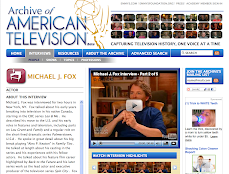
Actor/Writer Robert Culp on the creation of I Spy.Click here to watch the premiere episode, "So Long, Patrick Henry" (airdate: 9/15/65; written by Robert Culp) and other season one episodes of I Spy at You Tube's Classic Shows.I Spy at the Museum of Broadcast Communications' Encyclopedia of Television.I Spy page on Wikipedia.I Spy on IMDb.
Iconic actor Robert Culp's Archive interview is now available online! For I,Spy fans, here's a short segment from his interview:Click here to watch the entire 3-hour interview.Full Interview Description:Robert Culp was interviewed for three hours in Los Angeles, CA. Culp talks about his childhood interests and how he aspired to be an animator for Disney when he grew up. He talks about his acting training and his move to New York City. He explains how he was able to get work in television as an indirect result of the Hollywood Blacklist: since he was a newcomer. He discusseshis early experiences in Los Angeles as a struggling actor and describes his first role as a series regular on the series Trackdown, which he calls a “western Dragnet.” He describes some of the roles he had in a variety of the popular TV genres of the day— western, detective, medical, sci-fi— including his memorable parts on the classic sci-fi anthology The Outer Limits. He then speaks in great detail about the role and the series for which he is most closely associated: “Kelly Robinson” on I, Spy. For this series he talks about the on-location shooting, working with co-star Bill Cosby (and the controversial casting of an African-American lead), and talks about some of the series’ episodes that he wrote as well as acted in. He then discusses two other series for which he memorably appeared: The Greatest American Hero and Everybody Loves Raymond. The interview was conducted by Stephen J. Abramson on November 6, 2007.
Ruth Engelhart was associated with the William Morris Agency for over fifty years. She died at the age of 86 on July 23.Click here to watch Ruth Engelhardt's entire 8-part interview.Interview Description:Ruth Engelhardt was interviewed for three-and-a-half hours in Los Angeles, CA. Engelhardt vividly described her over 55-year association with the William Morris Agency. She recalled how she worked her way up from being a secretary to an executive in Business Affairs by earning her law degree attending night school. She discussed the structure of the Agency, the key figures in its executive suites, and its important television accounts. She talked about the packaging of such television series as The Life of Riley, The Danny Thomas Show, and I Spy. She spoke in great detail about the creation of one of the biggest hits of the 1980s, The Cosby Show. Additionally, Engelhardt talked about such topics as contract negotiations, the era of the Hollywood Blacklist, and the 1975 formation of CAA by ex-WMA agents. The interview was conducted by Karen Herman on October 9, 2003.7/31/08 UPDATE: Read a wonderful tribute to Ruth Engelhardt's legacy by Variety's Cynthia Littleton.
Earle Hagen, who composed (and whistled) The Andy Griffith Show theme, has died. The accomplished composer also wrote the memorable Dick Van Dyke Show theme music and won an Emmy Award for I Spy.Earle Hagen was interviewed by TV's Biggest Hits author Jon Burlingame in 1997. His entire five hour interview can be viewed here.Interview description:Mr. Hagen described the pleasure of working with producers Sheldon Leonard and Danny Thomas, and creating the themes, as well as writing the music for: The Danny Thomas Show, The Andy Griffith Show, The Dick Van Dyke Show, I Spy, and Mod Squad, to name a few.
Television legend Sheldon Leonard (1907-97) was one of the first people interviewed when the Archive of American Television began its pilot project in 1996.
The Archive celebrates the 100-year anniversary of Sheldon Leonard's birth today. Sheldon Leonard (1907-97) was one of the first people interviewed when the Archive of American Television began its pilot project in 1996.Although his interview is not yet online, here's a preview of part 3 ofSheldon's Leonard's Archive of American Television interview. In thisportion, Dick Van Dyke Show writer-producer Sam Denoff interviewsLeonard about The Dick Van Dyke Show and I Spy. PRESS THE PLAY ARROW IN THE PLAYER ABOVE TO WATCH THE SEGMENT NOW. Leonard was the executive producer of such classic television series as The Danny Thomas Show/Make Room for Daddy, The Andy Griffith Show, The Dick Van Dyke Show, and I Spy. He won two Emmy Awards— as director of Make Room for Daddy in 1961 and as producer of My World, and Welcome To It in 1970. In 1995 he was named an Honorary Life Member of the Directors Guild of America for his long-time services to the DGA as treasurer.Carl Reiner (Creator, The Dick Van Dyke Show) Sheldon was a great pedagogue, a great teacher. He had taught more people how to handle themselves as producers, writers, executives on television… everybody who ever came in Sheldon’s purview, they loved him because he was so good. If you talk to any of the people who ever worked with him, they’ll all have the same thing to say.Aaron Ruben (Producer-Director, The Andy Griffith Show)Sheldon Leonard was an actor, turned director, turned writer, turned producer, turned entrepreneur. He started on Broadway and appeared always as a gangster and in films… he was always a gangster because he talked out of the side of his mouth, even though he was very well educated and very articulate. Grant Tinker once said about Sheldon Leonard and the way he talked, he said he talks like a New Jersey longshoreman, using the words of William Buckley and it's true.Grant Tinker (Television Executive)Sheldon Leonard, who was a brilliant guy, instantly recognizable from playing sort of a Brooklyn tough guy in many movies and television shows, but off camera a very bright, creative director/writer. He didn’t actually sit at a typewriter and write but he contributed a great deal to the shows that he was involved with.Andy Griffith (Actor)I remember the first day [on The Andy Griffith Show]… Sheldon was a very bright astute man. The first day they shot with three cameras and the first day was always spent on the script. So that day I didn't have much to say at all. Artie Stander, Danny Thomas and Sheldon Leonard yelled at one another all day. I asked Sheldon if I could talk to him at the end of the day and he walked me to the gate. I said, if this is what television is, I don't think I can handle it. He said, "Andy, the, the star dictates what the attitude will be on the set. Danny likes to yell so we all yell [on The Danny Thomas Show]. If you don't want to yell, nobody will yell." That's the way it was.
Sheldon was a great pedagogue, a great teacher. He had taught more people how to handle themselves as producers, writers, executives on television… everybody who ever came in Sheldon’s purview, they loved him because he was so good. If you talk to any of the people who ever worked with him, they’ll all have the same thing to say.
Sheldon Leonard was an actor, turned director, turned writer, turned producer, turned entrepreneur. He started on Broadway and appeared always as a gangster and in films… he was always a gangster because he talked out of the side of his mouth, even though he was very well educated and very articulate. Grant Tinker once said about Sheldon Leonard and the way he talked, he said he talks like a New Jersey longshoreman, using the words of William Buckley and it's true.
Sheldon Leonard, who was a brilliant guy, instantly recognizable from playing sort of a Brooklyn tough guy in many movies and television shows, but off camera a very bright, creative director/writer. He didn’t actually sit at a typewriter and write but he contributed a great deal to the shows that he was involved with.
I remember the first day [on The Andy Griffith Show]… Sheldon was a very bright astute man. The first day they shot with three cameras and the first day was always spent on the script. So that day I didn't have much to say at all. Artie Stander, Danny Thomas and Sheldon Leonard yelled at one another all day. I asked Sheldon if I could talk to him at the end of the day and he walked me to the gate. I said, if this is what television is, I don't think I can handle it. He said, "Andy, the, the star dictates what the attitude will be on the set. Danny likes to yell so we all yell [on The Danny Thomas Show]. If you don't want to yell, nobody will yell." That's the way it was.

 Click here to watch the premiere episode, "So Long, Patrick Henry" (airdate: 9/15/65; written by Robert Culp) and other season one episodes of I Spy at You Tube's Classic Shows.
 Labels:
"I Spy",
From the Collection
Labels:
"I Spy",
From the Collection