Showing posts with label Genre: Children's Television. Show all posts

Monday, December 08, 2008

Tonight on ABC: A Perennial Favorite: "A Charlie Brown Christmas"

"A Charlie Brown Christmas" airs tonight, celebrating its 43rd anniversary. The timeless classic was the very first Charlie Brown special and Variety noted in its 1965 review that "author [Charles M.] Schulz is in such strong command of his charismatic characters that it would be successful in any medium." Variety also noted that "Snoopy, the wildly hedonistic dog was particularly well-conceived and stole every scene that he was in." The review spoke of the religious nature of the show: ".... Charlie Brown could not get into the spirit of Christmas, and his search for the meaning of the holiday only brought him into jarring contact with the crassness of his playmates. Just when it seemed as though the Scrooges of the world were right, little Linus took his thumb and blanket out of his mouth and briefly narrated the story of the birth of Jesus. The recital had a transforming effect on the tykes and they regrouped joined together by love."

The Archive of American Television interviewed both the special's producer Lee Mendelson and director Bill Melendez (1916-2008), as well as animator Phil Roman.

Bill Melendez on Linus's speech:
"It's one of the things that I get asked [about most] and we get more comment on, about that reading....Schulz said, you know, at one time Linus should come up and tell the real story of Christmas, the biblical story. And I said, no, Sparky, you can’t do that. That would be religious. And we can’t get religion into the shows. You’ll ruin it. Again, he looks up at me with those beady blue eyes of his and he said, 'Bill, if we don’t do it, who will?' I didn’t think that we had to do it anyhow. But I did it, I agreed with that philosophy that we could do it. And get away with it. Because the strip was gentle enough and it would not be taken, it would not be criticized. So, it was Schulz’s idea. And he was right... [it] just appeals to everybody. And no other show has ever done it."

Lee Mendelson on the special's use of music:
"Well, when we had the meeting about A Charlie Brown Christmas, and I say we only had a day for an outline, and [Charles] Schulz wanted to talk about what he felt was the true meaning of Christmas. He said I think we’ve lost that. So we kind of worked backwards from that. We wanted to do the true meaning of Christmas. I wanted to use different kinds of music. We knew we’d use traditional Christmas music, and we would use some Beethoven because Schroeder played Beethoven. But when we did [a previous] documentary we hired a fellow named Vince Guaraldi to do the music on the documentary, and I thought it might be fun to use some of that music on the Christmas show. And we called Vince, and he wrote an opening title song for the show. And I remember I thought maybe we should put some words on it, and I just wrote -- scribbled some words down on an envelope, 'Christmas time is here, happiness...' and so forth, and never thought much about it. And I think the music was critical to it’s acceptance. And we thought of different elements about the Christmas tree and so forth, and put it all down in the outline, and the outline pretty much is the way the show eventually evolved. But I think that the Guaraldi music was crucial to it’s success because that was the first time a cartoon had used jazz, had used adult music. That raised it a certain level."

Tuesday, February 19, 2008

40 Years Ago: "Mister Rogers' Neighborhood" Premieres

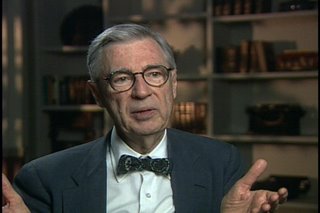
Forty years ago, on February 19th, 1968, Mister Rogers' Neighborhood premiered. Originally titled Misterogers (as its precursor had been called in Canada) the show emanated from WQED Pittsburgh and aired on EEN (Eastern Educational Network). The series moved to PBS in 1970. Production ceased in 2001. Sadly, Fred Rogers passed away in 2003; the series continues to air nationwide.


In 1999, the Archive of American Television interviewed Mr. Rogers. Click here to Fred Rogers' 9-part interview (and be on the lookout for puppet cameos). Also, check out this link on the show's homepage for Mister Rogers trivia.

A favorite excerpt from the interview:

"My mother, as long as I could remember, made at least one sweater every month. And at Christmas time she would give us each a hand-knit sweater. And so, until she died, those zipper sweaters that I wear on The Neighborhood were all made by my mother. We would open up the boxes at Christmas and, and we’d all try on the sweaters. Then she would say, 'Okay, now what kind of do you want next year? Now, I know what kind you want, Freddy, you want the one with the zipper up the front.' There are ties that many people don’t know, just watching certain programs and it makes the experience so much deeper to know from whence Mr. McFeely came or where the sweaters came from. And the music is a huge part of my work. That was always my way of saying who I was and how I felt. In those days, you didn’t speak your feelings as much as express them artistically. I was always able to cry or laugh or say I was angry through the tips of my fingers on the piano. I would go to the piano, even when I was five years old, and start to play how I felt. So it was very natural for me to become a composer. Having written all of the music for The Neighborhood, I feel as if that’s one of my gifts to children. Here is a way that doesn’t hurt you or anybody else, to say who you are and how you feel."
Interview description:
In his 4-1/2 hour interview, Fred Rogers described his work as the creator and host of Mister Rogers’ Neighborhood, which began its run in 1968. He described the show’s evolution, which started with Misterogers which he produced in Canada for the CBC. He described each aspect of the show including the origin of his trademark sweaters. He described his early years in television working as a floor manager for NBC on such shows as NBC Opera Theatre, The Kate Smith Hour, and The Gabby Hayes Show. He detailed his move into public television in 1953 with his work as the program director for WQED, Pittsburgh. He described his first children’s program The Children’s Corner (1954-61 WQED; 1955-56 NBC), which introduced several puppets later used on Mister Rogers. He talked about the importance of children’s programming and his longevity as a childrens’ show host. The interview was conducted on July 22, 1999 at WQED in Pittsburgh, PA.

Sunday, September 23, 2007

"The Jetsons" Turns 45!

On September 23, 1962, following the success of The Flintstones, Hanna-Barbera's animated sitcom The Jetsons premiered as one of the first color television programs on ABC. Hard to believe, but only 24 "classic" episodes were made at that time -- another 50+ episodes were later created in the 1980s.

The Creation of "The Jetsons" - From Part 5 of Joseph Barbera's 7-part interview

When the network came in and said, “You want to do another show.” It's not particularly brainy to say, “Well, with stone age [The Flintstones] here, let’s go into the future there.” So we started on that basis. And what I did was I created a living quarters that were based actually on the remnants of the 1939 New York World's Fair. And there’s still a couple of those buildings left on the way in from the airport. Circular buildings up on a taff. So I converted those to apartments with hydraulic lifts in case the smog was up there, you would just lift the apartment above. What I was doing looking into the future. This is what we can do in the future. Now the same thing applied to parking. Parking that’s a problem of the future. A problem right now. So in that particular show, what we did in parking for The Jetsons, when he came into a stop, and pressed button, his vehicle became a briefcase that he carried. Later on I converted where it became a box like a shoe box that fitted into a slot like a lsafety deposit box. Here’s my parking space right here. So the idea was to make life easier and smoother and more interesting. His job was to simply go in in the morning and sit down and press one button. Anything easier than that? ... That’s future living -- parking, and buying clothes. Like the way I had it in The Jetsons is you stand behind the board, and you flash the clothes on the screen below you. Well you can see your dress before you buy it or your suit, or something like that. And you don’t have to try it on even or put it on. I had the sky crowded with vehicles just like it is today, except there was long lines. And they pick up on this because there’s a highway with no crowd on it, and you cut over there and in two seconds, they gridlock again. So that’s about the way I handled that stuff.


Full interview description:

Joseph Barbera discussed his start as a young animator at the Van Beuren Studios in New York, before his move to California and MGM's cartoon studio. He recalled working for executive Fred Quimby, and his eventual partnership with William Hanna at MGM. This collaboration with Hanna ultimately led to their own cartoon production company, and Barbera shared many stories about the creation of some of their more memorable characters and shows including: Tom and Jerry, Quick Draw McGraw, Yogi Bear, The Flintstones, Top Cat, The Jetsons, and The Smurfs. The Archive of American Television interview was conducted in 1997 by Leonard Maltin and Sunny Parich.

Click here to access the entire 7-part interview.

Tuesday, June 12, 2007

Don Herbert, TV's "Mr. Wizard," Passes On

Don Herbert, known to television viewers for four decades as "Mr. Wizard," has died at age 89. The first incarnation of his educational science show, Watch Mr. Wizard, began on March 3, 1951 on WMAQ (WNBQ) in Chicago. The show continued in various formats, finding new life in the 1980s as the Nickelodeon series Mr. Wizard's World. Herbert also developed the 90s series Teacher to Teacher with Mr. Wizard that highlighted exemplary elementary science teachers and projects.


Don Herbert was interviewed by the Archive of American Television's Karen Herman on January 24, 2005.


Interview Description:
Don Herbert described his early years as an actor on stage and radio before turning to television where he created the classic children’s science series Watch Mr. Wizard. He detailed his hosting of the show, as well as working with his young assistants. He talked about his simultaneous work as G. E. Theater’s “progress reporter,” hosting a different three-minute commercial segment for each episode through the majority of the run. He talked about the later incarnations of the “Mr. Wizard” franchise. He also mentioned his appearances on morning and late-night television talk shows.

There is also a wonderful Mr. Wizard website -- click here to access.

Sunday, February 04, 2007

Reminder: Fred Rogers Memorial Scholarship Deadline is Coming Up


Entry deadline is February 15, 2007.

The Academy of Television Arts & Sciences Foundation (which runs the Archive of American Television), in association with Ernst & Young LLP, is offering two scholarships in honor of Fred Rogers, the creator and host of Mister Rogers’ Neighborhood. The scholarships are intended to support and encourage aspiring upper division or graduate students to pursue careers in children’s media and further the values and principles of Fred Rogers’ work. To see our original post about this amazing opportunity (and about our interview with Fred Rogers himself), click here. Hurry, there are only a few more "snappy new days" left to apply!

Click here for full Fred Rogers Memorial Scholarship application information.

Friday, December 15, 2006

Fred Rogers Memorial Scholarship Applications Are Now Being Accepted!


The Academy of Television Arts & Sciences Foundation, in association with Ernst & Young LLP, is offering two scholarships in honor of Fred Rogers, the creator and host of Mister Rogers’ Neighborhood. The scholarships are intended to support and encourage aspiring upper division or graduate students to pursue careers in children’s media and further the values and principles of Fred Rogers’ work.

From 1967 to 2001, Fred Rogers produced his daily children's television program, celebrating imagination and play, exploring children's feelings and sense of self worth, and treating young viewers with love and respect. Mister Rogers' Neighborhood continues to air on PBS stations throughout the United States and remains the gold standard of how television can enlighten, educate and increase social consciousness and understanding. The Archive of American Television was very honored to conduct his four-and-a-half hour videotaped interview (puppets and all) in 1999. Click here to access Fred Rogers' Archive interview.

Two $10,000 scholarships are awarded annually to two qualified applicants. In addition to the monetary award, successful applicants are mentored by children’s programming professionals during the academic year.

The Fred Rogers Scholarships are made possible through the generous underwriting of Ernst & Young.

Entry deadline is February 15, 2007.

Click here for full Fred Rogers Memorial Scholarship application information.

Saturday, November 18, 2006

Bob Keeshan's ("Captain Kangaroo" and TV's First Clarabell the Clown) Interview is now Online


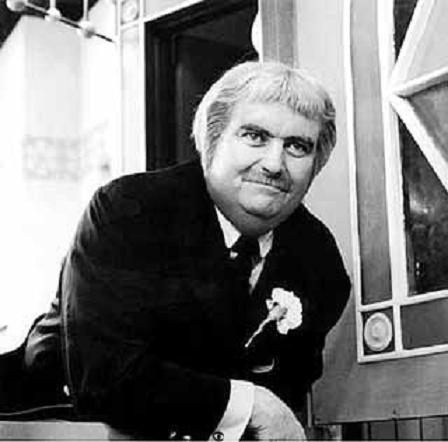
Remember Clarabell the clown on The Howdy Doody Show? Or what about Captain Kangaroo, with his menagerie of "Dancing Bear," "Mr. Moose," and "Mr. Greenjeans"? Bob Keeshan, best known as television's "Captain Kangaroo" was interviewed by the Archive of American Television in 1999 and it's now accessible on Google Video.

Interview Description:

Mr. Keeshan related his experiences as an NBC page before going to work for "Buffalo" Bob Smith. Keeshan talked about the beginnings of Smith’s Howdy Doody Show and how he was eventually transformed into the show’s clown, Clarabell. Keeshan discussed his four years on the show, and his eventual falling-out with Smith, which led to Keeshan's departure. He talked about starring in two local New York childrens’ programs before CBS tapped him to star in his own show, which ultimately became Captain Kangaroo. He talked about executive producing and starring in the program for almost 30 years and discussed the ensemble cast and classic moments. The 3-1/2 hour interview was conducted by Karen Herman in Queechee, Vermont on October 19, 1999.

Click here to access the entire interview. (The interview is done chronologically, so it's best to watch the parts in order.)

Friday, April 28, 2006

Puppeteer (and Archive Interviewee) Carroll Spinney Honored with a Lifetime Achievement Award


Archive interviewee Caroll Spinney, the puppeteer who plays the roles of Big Bird and Oscar the Grouch on Sesame Street, was honored with this year’s Lifetime Achievement Award at the 33rd Annual Daytime Craft Emmy Awards. Spinney was chosen for his work entertaining and educating children for nearly four decades, since the series debut in 1969. His characters have been seen on more than 4,000 episodes, as well as Sesame Street television specials that have taken Spinney to China, Japan, Australia, France, Germany, Canada, and the United Kingdom. Spinney starred in the feature film Follow That Bird and has performed on a number of other shows, including The West Wing and Hollywood Squares.

Mr. Spinney's Archive of American Television interview was conducted on May 12, 2001.

Click here to access Carroll Spinney's interview segments.


Sunday, April 23, 2006

Fred Rogers' Legacy Continues...


Congratulations to the winners of the Fred Rogers Memorial Scholarship presented at Saturday's 33rd Annual Daytime Creative Arts Emmy Awards (see the press release below for details). In 1999, the Academy of Television Arts & Sciences Foundation's Archive of American Television interviewed Mr. Rogers in-depth about his entire television career. Watch this amazing interview (and look for a few cameos by some of his favorite puppets) and see why he continues to be an inspiration to so many.

Interview description:

In his 4-1/2 hour interview, Fred Rogers described his work as the creator and host of Mister Rogers’ Neighborhood, which began its run in 1968. He described the show’s evolution, which started with Misterogers which he produced in Canada for the CBC. He described each aspect of the show including the origin of his trademark sweaters. He described his early years in television working as a floor manager for NBC on such shows as NBC Opera Theatre, The Kate Smith Hour, and The Gabby Hayes Show. He detailed his move into public television in 1953 with his work as the program director for WQED, Pittsburgh. He described his first children’s program The Children’s Corner (1954-61 WQED; 1955-56 NBC), which introduced several puppets later used on Mister Rogers. He talked about the importance of children’s programming and his longevity as a childrens’ show host. The interview was conducted on July 22, 1999 by Karen Herman in Pittsburgh, PA.

Click Here to Access Fred Rogers Interview Segments

NATHALIE CARRICK AND NICHOLAS DEYSHER NAMED RECIPIENTS OF ACADEMY OF TELEVISION ARTS & SCIENCES FOUNDATION FRED ROGERS MEMORIAL SCHOLARSHIP

Graduate Students to Each Receive $10,000
for Their Work in Children’s Media

NORTH HOLLYWOOD, CA. April 21, 2006 – The Academy of Television Arts & Sciences Foundation along with Ernst & Young LLP jointly announced that Nathalie Carrick and Nicholas Deysher are the recipients of the second Fred Rogers Memorial Scholarship. The announcement was made by Nancy Steingard and Vicki Ariyasu, Governors of the Television Academy's Children's Programming Peer Group and Andy Sale, Ernst & Young’s Media and Entertainment Leader for the Pacific Southwest Area.

The scholarships will be presented to the students at the 33rd Annual Daytime Creative Arts Emmy Awards on Saturday, April 22 in Los Angeles by Daytime Emmy® nominee, J.D. Roth (“Endurance: Tehachapi"). Carrick, who is currently pursuing a Ph.D. in Developmental Psychology at the UC Irvine, will be given the Research Scholarship. Deysher, a grad student in the University of Miami’s Media Writing and Production program, will be given the Production Scholarship. Each will receive $10,000 to support their aspiring careers in children's media and furthering the values and principles of Rogers' work. In addition to the monetary award, both will be assigned a mentor from the Television Academy's Children's Programming Group who will work with them during the academic year.

"Both Nathalie and Nicholas are students that devote their time to the field of children's media and we are thrilled to be able to award these scholarships to them,” said Steingard. “They have both demonstrated a commitment to programming that reflects the values, creativity and spirit of Fred Rogers."

Added Ariyasu, "We couldn't ask for two better recipients to be emissaries of Fred Rogers and the Television Academy. Nathalie and Nicholas are both sincere and passionate about children's media and their work truly best represents Rogers' vision of using television to enlighten and inspire young children."

“Ernst & Young is proud to underwrite this unique scholarship program,” commented Andy Sale, Ernst & Young’s Media and Entertainment Leader for the Pacific Southwest Area. “We share a commitment to promoting quality education and hope this scholarship encourages others to pursue a career in educational programming for children.” ....

Click here to view the entire press release.